

Tim Eldred
Tim Eldred | Captain Harlock & Armored Trooper Votoms | A Portrait
Tim Eldred | Captain Harlock & Armored Trooper Votoms | A Portrait
Couldn't load pickup availability
Tim Eldred is one of the very few American artists of his generation to build a real career inside the world of anime and manga, at a time when that influence was still rare and unfashionable in Western comics.
Across two decades of work for Eternity Comics and CPM Comics, he became the primary American artist for Leiji Matsumoto's Captain Harlock, drew the only English-language Armored Trooper Votoms comic ever produced, and eventually created and drew his own Star Blazers series for Argo Press.
Eldred's path into professional comics started as fandom. Long before any studio would hire him, he was already producing his own Votoms Viewer's Guide, a substantial fanzine built from scratch: consulting translators, tracking down reference material, and hand-lettering English text over stills from a series that had no official release in America.
It was this fanzine, circulating through anime fan networks, that eventually caught the eye of the people at Central Park Media (CPM) and helped set in motion the licensing of Votoms for American release, years before Eldred ever got the chance to draw it professionally.
His break into published comics came through Eternity Comics, an imprint of Malibu Graphics, where he connected with the staff in June 1989, four months before Captain Harlock #1 hit shelves.
The assignment had already gone to Ben Dunn, the artist who'd brought the Harlock license to Malibu in the first place, so Eldred spent the next year watching issues roll out one by one while working on his own titles.
His way in was Emeraldas, Harlock's female counterpart: when Eternity spun off a four-issue Pirate Queen Emeraldas miniseries, Eldred took over the art from Ben Dunn starting with issue #3.
From there he moved straight onto Captain Harlock itself, finishing #12 from Dunn's rough pencils before taking full command with #13. What followed was, in Eldred's own words, "a nice long run": 15 issues drawn back to back, spanning Deathshadow Rising (#1–6), a Christmas Special, Fall of the Empire (#1–4) and The Machine People (#1–4).
17 issues of original Harlock material in total, on top of the two Emeraldas issues that got him there. Eldred worked in close visual dialogue with both of Harlock's core sources: Matsumoto's own manga linework and the character designs of the 1978 TV anime, whose art director Kazutaka Miyatake had also designed the extraordinarily complex Arcadia, a ship Eldred has since described as one of the hardest things he ever had to learn to draw consistently.
Armored Trooper Votoms came next, and it was the project he had always wanted to make. Based on Ryosuke Takahashi's 52-episode 1983–84 "real robot" anime, with mechanical designs by Kunio Okawara, Votoms had already spawned OVAs, novels, games and a manga by Minoru Nonaka serialized in Comic BonBon.
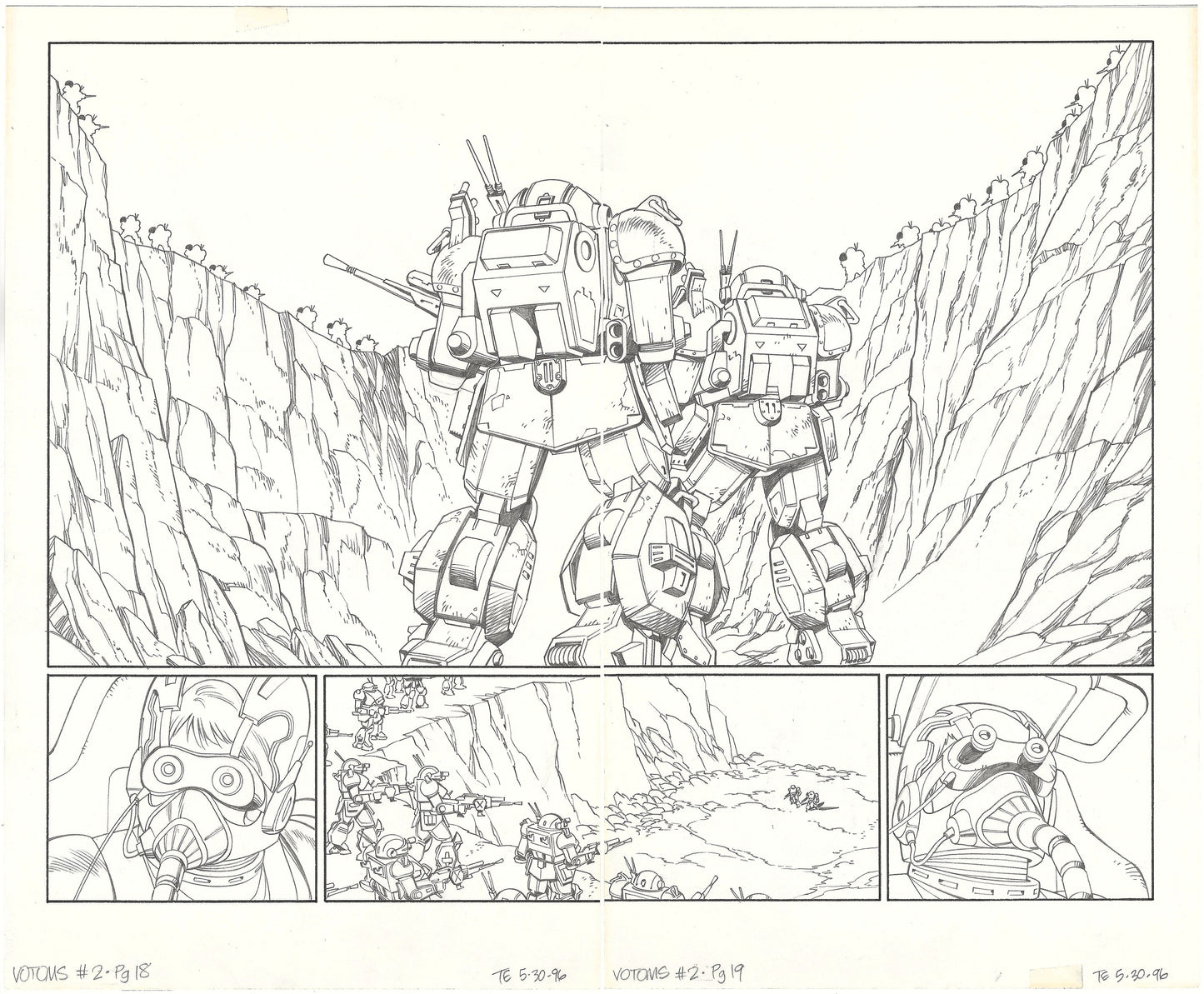
When CPM Comics secured both video and publishing rights in 1996, Eldred finally got the assignment his own fanzine had helped make possible. He worked directly from his VHS tapes, extracting frames and building them into his layouts as visual reference, so the finished art stayed as close as possible to the Japanese source rather than reinventing it as an American comic.
Votoms #1 was published in July 1996, planned as the first of a four-issue miniseries opening with Roots of Ambition and building toward the start of the original TV series.
It never got that far as single issues: the American comics distribution market collapsed at exactly the wrong moment, and only that first issue ever reached stores.
Eldred was allowed to finish the art regardless, and the complete story appeared a year later as the Supreme Survivor graphic novel, released in sync with the anime's American home video debut.
Beyond Harlock and Votoms, Eldred's career sits at the same crossroads, with titles like Star Blazers, M.D. Geist and Cyber City Oedo 808. Star Blazers stands apart from the rest: rather than adapting someone else's assignment, Eldred created and drew it himself for Argo Press, running the series well past a dozen issues and staying with it longer than almost anything else in his career.
None of this happened in Japan, and none of it was a simple translation job. These were original American comics or Amerimanga, made from scratch, inside licensed Japanese universes, years before "manga influence" became a marketable label in Western comics.
Captain Harlock's own afterlife in European pop culture, where Albator has remained a defining pop-cultural touchstone since its 1980 broadcast on Antenne 2, is part of what makes this body of work worth preserving: an early Western reinterpretation of Matsumoto's universe, made by one of the very few artists who ever got to work inside it directly.
Share