

Sōji Yamakawa
Shōnen Ace and the End of the Emonogatari Era | Art by Sōji Yamakawa
Shōnen Ace and the End of the Emonogatari Era | Art by Sōji Yamakawa
Couldn't load pickup availability
Shōnen Ace and the End of the Emonogatari Era
Shōnen Ace was first serialized from 1954 to 1957 in Sankei Shimbun (a daily national newspaper) and was later collected in book form between 1959 and 1961 as part of the Sankei Jidō Bunko series.
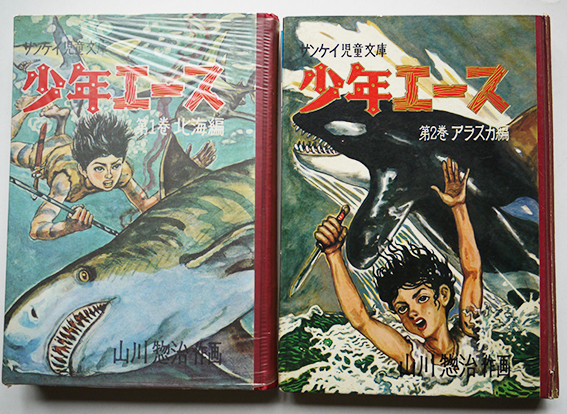
This masterpiece by Soji Yamakawa follows a Japanese boy named Makoto, who survives after being cast into the sea near Alaska.
Raised by seals and eventually integrated into their world, he is given the name “Shōnen Ace” after coming into conflict with human hunters. His initial adventures are set primarily in northern environments, ranging from Hokkaidō to Alaska. The original Shōnen Ace books, published by Kadokawa Bunko, were structured into narrative sections: the Hokkaidō Arc, the Alaska Arc, and the Killer Whale Arc.
To Soji Yamakawa, the "Northern World" was one vast, connected wilderness.
Although Makoto fell into the water near Alaska, his adventures frequently brought him to the coasts of Hokkaidō in Northern Japan. The entire North Pacific served as a massive stage for his hero, representing the last stronghold of the wild.
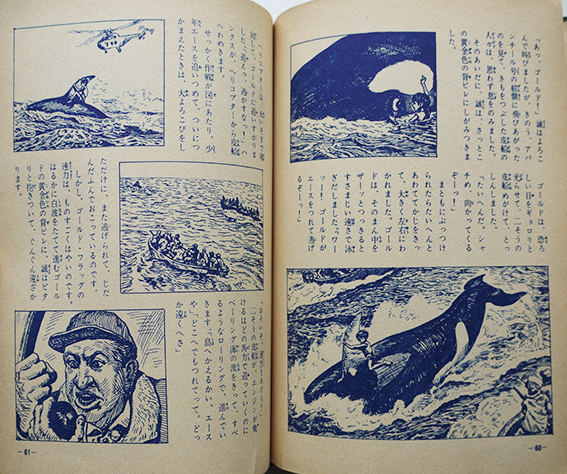
The "Killer Whale Arc" serves as the conclusion of the original series, focusing on Makoto’s alliance with the giant, intelligent Killer Whale, Gold Flag.
Together, they fight against hunters and high-tech whaling fleets.
Yamakawa portrayed nature as something to be protected, not merely conquered. At a time when whaling was a massive industry in Japan (the 1950s and 60s), Yamakawa framed sea creatures as intelligent allies with their own rights. By presenting whaling fleets as villains, he addressed a conflict that would not become a major global political issue until nearly 20 years later.
These early volumes correspond to the collected material from 1954 to 1957. However, the story continued in the Chubu Nippon Shimbun (now Chūnichi Shimbun, newspaper) under the title :
Zoku Shōnen Ace (1959–1961).
This sequel, Zoku simply meaning "continuation", was never widely collected into book form and survives primarily in newspaper format.
In the original story, Makoto grew from a boy trying to survive into a "General of the Seas," an environmental hero fighting large-scale threats.
Zoku took a bold leap in artistic freedom; Yamakawa’s storytelling, driven by imagination rather than maps, moved Makoto from the icy North to tropical Africa. In this new setting, Makoto encounters new threats alongside his companion Mary and a newfound chimpanzee ally. Together, they face hunters, "Leopard Men," rhinoceroses, elephants, ostriches and …
While these animals and tribes do not naturally coexist in the same regions, Yamakawa prioritized visual spectacle over geographic accuracy. By mixing the "Hero of the North" with the jungle elements of his greatest hit, Shōnen Kenya, he created a "fantasy wilderness."
This leap in artistic freedom was likely a creative attempt to keep the story exciting during the rise of modern manga, a strategic move to merge his most successful ideas into new adventures, proving that the spirit of the "wild boy" was exactly what young readers craved.
Additionally, as the scenery changed, so did the style. In its original form, Shōnen Ace belonged to the tradition of emonogatari, a storytelling format that combines text blocks with illustrations rather than using consecutive panel-based narration.
Its structure reflects pre-manga traditions such as kamishibai, which were still widely used in the 1950s. However, the later transition toward more sequential, manga-like action reflects Yamakawa’s struggle to adapt his lone artistic vision to an industrializing comic market.
Zoku Shōnen Ace marks a clear departure from the original series' structure.
This sequel is presented in a more contemporary manga style, with a stronger emphasis on sequential drawing and modern character design.
This transition is essential for understanding the work’s reception: while the original Shōnen Ace belonged to the illustrated storytelling tradition of the early 1950s, the sequel aligns more closely with the emerging postwar manga language that became dominant in the 1960s.
This stylistic shift arrived at a critical turning point. On March 17, 1959, two major weekly magazines emerged, forever changing the industry:
- Weekly Shōnen Sunday (Shogakukan)
-
Weekly Shōnen Magazine (Kodansha)
Consequently, the reception of Yamakawa's later work was marked by a sense of "stylistic limbo."
For older fans, the move toward sequential manga sacrificed the soul of his painterly realism. For the new "baby boomer" generation, however, the work could not match the narrative velocity of Osamu Tezuka’s industrial studio system.
Ultimately, this transition serves as a historical record of a genre's struggle to stay relevant. It was a modernizing effort that arrived just as the era of the lone e-monogatari artist was being surpassed by the rise of modern, mass-produced manga. Yamakawa’s late transition to "regular" manga remained deeply rooted in his personal artistic philosophy and his resistance to an industry that was moving faster than a single hand could draw.
Yamakawa was a committed traditionalist who viewed himself first and foremost as a painter. He harboured a strong sense of rivalry, and even a degree of contempt, toward modern manga, believing that its “cartoony” style and reliance on speech bubbles “dirtied” the artwork.
He believed in the emonogatari format because it allowed him to present “one beautiful painting” per page, and he wanted children to appreciate high-level art rather than what he saw as the simplified sketches of rising manga artists such as Osamu Tezuka.
While publishers were once desperate for his work, the relationship began to deteriorate as tastes changed. By the late 1950s, the “manga revolution” demanded fast-paced, multi-page storytelling. Yamakawa’s labour-intensive, realistic style could not keep up with the weekly production cycles of the new manga magazines. Many publishers pressured him to adopt more manga-like layouts in order to survive, but he largely refused, leading to a decline in his presence in major publications.
In 1967, he went so far as to found his own publishing company, Tiger Shobō, in an attempt to prove that e-monogatari could still succeed. He launched the magazine Wild, a high-quality publication conceived as a kind of artistic manifesto. However, it failed within ten months, largely because it was too expensive to produce and too slow in its visual rhythm for a generation of readers accustomed to the rapid pace of magazines such as Shōnen Magazine and Shōnen Sunday. The failure led to his bankruptcy and effectively marked the end of the e-monogatari era.
The 1959 sequel Zoku Shōnen Ace occupies a difficult “middle ground” in publishing history. By the time it was serialized in the Chubu Nippon Shimbun, the emonogatari boom had effectively ended. Major publishers such as Kadokawa were focusing on collecting modern manga, leaving older-style newspaper serials behind.
Although Zoku Shōnen Ace incorporated more manga-like elements, such as increased panelling and reduced text, it remained fundamentally a newspaper serial. Converting these layouts into the tankōbon format used for the original series would have required extensive re-editing, which publishers at the time deemed financially unviable. As a result, while the first three volumes of Shōnen Ace remain accessible through reprints, the sequel survives almost exclusively in newspaper archives, microfilm and the original art recently found in the archives.
The rivalry between Yamakawa and Osamu Tezuka symbolizes a broader “changing of the guard” in Japanese popular culture: the moment when the stately e-monogatari tradition gave way to cinematic story manga. In the early 1950s, Yamakawa was the undisputed “King of Adventure,” positioning himself as both artist and educator. He famously looked down on the emerging manga style, arguing that children deserved realistic, anatomically correct imagery.
A famous popularity poll in Omoshiro Book revealed a decisive shift: children overwhelmingly preferred Tezuka’s fast-paced, dynamic manga over Yamakawa’s static, painterly illustrations. Yamakawa reportedly felt betrayed by this result, yet rather than adapting, he doubled down on his artistic principles.
Ironically, Tezuka deeply respected Yamakawa’s draftsmanship. He admired the anatomical precision and the visceral power of his illustrations, and studied his work to improve his own depictions of animals and nature. This influence can be seen in the more realistic aspects of Tezuka’s later works, such as Black Jack.
At the same time, Tezuka remained critical of what he saw as the static nature of Yamakawa’s compositions, arguing that while a single illustration could be a masterpiece, it lacked the cinematic flow that defined manga.
Tezuka later reflected on this difference with a striking comparison in his autobiography Boku wa Mangaka (“I am a Manga Artist”): Yamakawa’s images were like magnificent oil paintings to be contemplated individually, whereas his own manga resembled flickering film, meant to be consumed rapidly, with energy emerging from sequence rather than from a single image.
This distinction helps explain why works such as Yamakawa’s Pecos Bill or Shōnen Ace ultimately gave way to the manga era. In Yamakawa’s hands, a Western scene became a landscape to be admired in detail; in Tezuka’s, it became an action sequence defined by movement and pacing. The shift was not a matter of artistic superiority, but of changing audience expectations in the postwar period, moving from slow, contemplative viewing to rapid, cinematic consumption.
After the decline of e-monogatari, Tezuka spoke of Yamakawa with a sense of respect and nostalgia, viewing the failure of Tiger Shobō as the tragic end of a refined but outdated artistic tradition.
While Tezuka “won” the commercial transition, he acknowledged Yamakawa as the superior illustrator, recognizing that his own success came from redefining the medium rather than surpassing him in painterly skill.
The collapse of Tiger Shobō thus represents more than a business failure. It marks the symbolic end of one visual culture and the rise of another: the replacement of the “mythic hero,” embodied in Yamakawa’s noble realism, by the fast-moving “pulp hero” of modern manga. While Yamakawa’s artistic world faded, it remains a high-water mark of Japanese realistic adventure art, a “beautiful, static frontier” ultimately overtaken by the flickering motion of manga.
Share

