

Osamu Tezuka
Osamu Tezuka’s Astro Boy / Big X Kamishibai for Koide Shinkosha, c. 1964
Osamu Tezuka’s Astro Boy / Big X Kamishibai for Koide Shinkosha, c. 1964
Couldn't load pickup availability
In 1964, Koide Shinkosha, a Japanese publisher and maker of children’s games and paper goods, produced this stunning and very rare kamishibai, which lies at the heart of a remarkable collection of original art by Osamu Tezuka.
Koide, alongside companies such as Hanayama, was an important force in the development and distribution of ‘Trump’ card games, board games and puzzles during the post-war Shōwa era. They are best known for producing highly sought-after vintage games and karuta cards featuring iconic 1960s anime and manga characters.
The original colour illustrations used in the production of this rare television-shaped kamishibai were created by none other than the godfather of manga, Osamu Tezuka, at a time when Astro Boy was already one of the most recognizable manga and anime characters to come out of Japan.
Koide Shinkosha and Tezuka cleverly combined two properties: the already dominant Tetsuwan Atomu and the newly launched Big X. Each character received its own impressive opening image, allowing the theater to be displayed with either Astro or Big X at the front.
Astro was the established star, instantly recognizable through the long-running manga and the huge success of Mushi Production’s television series; Big X was the newer attraction, still fresh from its late-1963 magazine debut. The set therefore functioned both as a toy with Astro Boy and Big X and as early publicity for Big X.
The format itself is a remarkable meeting point between old and new media. It operated like a traditional kamishibai: a series of illustrated cards was placed into a frame while narration on the reverse guided the person telling the story. Yet the frame was designed as a television set, transforming the established paper-theater tradition into a toy shaped by the still-young age of television.
Children could effectively stage their own Astro Boy broadcast at home. The product did not merely reproduce television imagery; it translated the television phenomenon back into a performative object.
The Astro Boy section appears to present a self-contained adventure made specifically for the paper theater.
The cards show Astro in an alien kingdom with knights and a princess who needs saving, a world of flying saucers, a purple monster, conflict and rescue.
The story has not been linked to a specific manga or television episode, and no individual title is printed on the cards. It is therefore more convincing to see it as a short Astro Boy scenario devised or adapted especially for this format, built around clear action and strong images that would work immediately for a young audience.
The Big X material draws on the early Big X stories involving the giant rat, part of the postwar plot in which the legacy of the wartime Big X project resurfaces and the attack of V3.
Big X had only begun in late 1963, while its television adaptation would not start until August 1964. The presence of Big X alongside Astro places this object at a specific point in Tezuka’s career:
Astro was already a mass cultural phenomenon, while Big X was being introduced as a new hero.
By 1964, Astro Boy was no longer simply a successful manga character. The original Tetsuwan Atomu serial was still running in Kōbunsha’s Shōnen, and the Mushi Production television series had been on air since January 1963 and was already in its second year.
Astro had become the face of Tezuka’s new animation studio, a national television success and a rapidly expanding merchandising property.
That same year saw the launch of the Astro Boy Club, the beginning of Kappa Comics’ thirty-two-volume Astro Boy edition and the publication of Suzuki’s ten-volume Osamu Tezuka Complete Works. Astro also received the Special Award at the second Television Journalists Association Awards.
This Koide Shinkosha kamishibai belongs directly to the great expansion of Astro beyond manga and television into toys, games, books and licensed objects.
At this stage, Astro merchandising was widespread but fragmented. Different companies handled toys, paper goods, stationery, food promotions, games and household products.
Koide Shinkosha belonged to this licensing environment. They were neither an animation studio nor a major Tezuka publisher, but a maker of “Trump” playing cards, character games and such related paper products.
The television-shaped kamishibai was innovative. It uses a traditional paper format but makes television itself part of the product design.
It reflects the period before Astro merchandise became more closely monitored and standardised, when many companies were still inventing their own ways of turning the character into something children could own and play with.
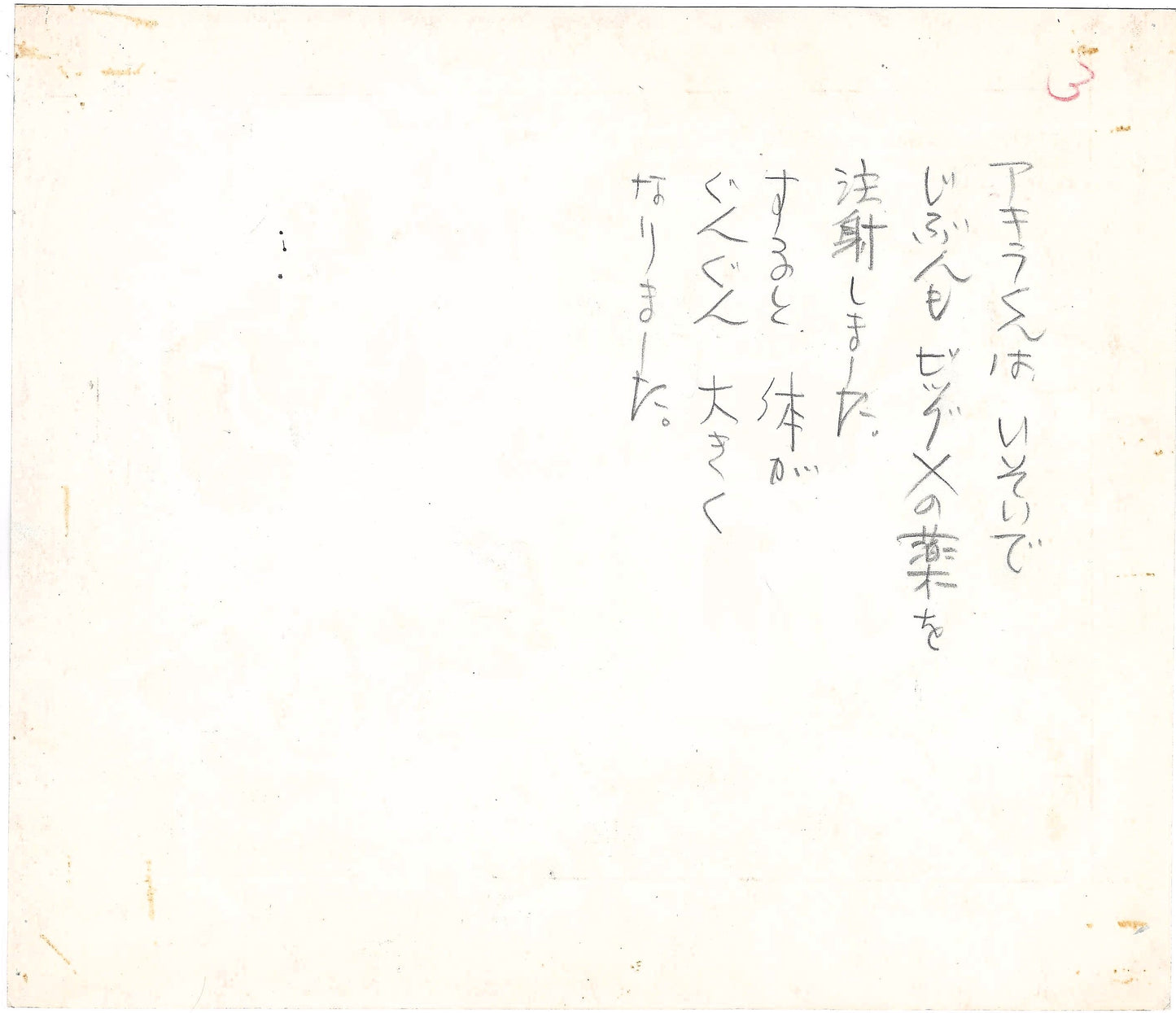
The surviving original art is particularly important because it preserves both sides of the production process. The fronts are finished, highly detailed colour illustrations created for reproduction in the published theater. The reverse carries handwritten narration and scene information in Osamu Tezuka’s own hand, exactly as in the published kamishibai.
That same text was reproduced on the printed cards. The originals are therefore not merely illustrations; they are historical documents in which Tezuka’s visual art and narrative voice remain physically joined.
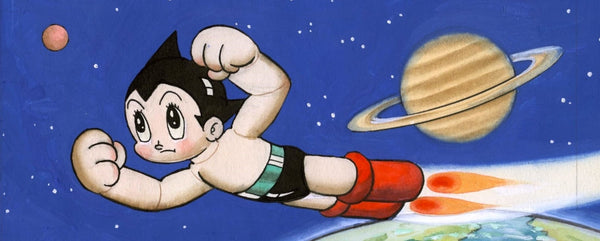
The blue Astro Boy opening image is the most outstanding and striking piece in the set. It is a fully resolved Astro Boy icon created to function as the face of the entire kamishibai. The image turns Astro into an emblem. There is no villain, no secondary character and no plot to decode. Everything supports the central image of Astro in flight.
The blue background is unusually rich and controlled, giving the work a more finished, almost poster-like quality. The Earth is not a quick symbolic globe. It is carefully painted with coastlines, landmasses, cloud-like texture and tonal modelling, while Saturn is rendered with considerably more care than one would expect from a children’s product cover.
The red boots and green belt stand out sharply against the blue field, while the diagonal flight path creates a clean, powerful movement across the image. The image sells the entire object from the first glance. It behaves like a cover in the strongest sense: it gives the whole Astro fantasy in one image.
This distinction becomes clear when compared, for example, with Tezuka’s later published colour illustrations, such as the 1965 Shōnen title-page original from Robio and Robiette, exhibited at the Centre Pompidou in 2024. This is an excellent narrative illustration, built around a specific action or scene and a particular chapter.
The Koide image works differently. It is not tied to one plot point. It does not introduce a villain, a setting or a story. It presents Astro in his most complete symbolic form: flying through space above Earth, surrounded by planets and stars, as a child robot who stands for science fiction, adventure, television and the future.
All this is to say that neither the title illustration nor any of the others was created lightly. These were not some quickly created illustrations. The attention to detail and the balanced use of colour point in the direction of a skilled artist.
The question of authorship is therefore worth approaching carefully.
Tezuka worked with many assistants, and by the early 1960s the boundaries between manga work, animation work and commercial illustration could be a little fluid. Several artists around Mushi Production were technically capable of drawing Astro Boy at a high level.
The question is not whether assistants existed or could draw high-quality colour artwork, but whether this set of original drawings can be visually or historically connected to any particular one.
Shotaro Ishinomori is a fascinating first historical possibility. In 1955, while still a teenager, he helped Osamu Tezuka on an Astro Boy supplement and proved capable of drawing characters as well as backgrounds.
Tezuka reportedly altered some of Ishinomori’s character work because the young artist’s own hand was already too recognisable. Ishinomori would have been a wonderful attribution in his own right, but his documented Astro assistance belongs to the mid-1950s, almost a decade before the Koide theater. By 1964, he was already an established independent creator.
Fumio Hisamatsu is another important name in Tezuka’s circle. He entered Tezuka’s studio at a young age and later proved fully capable of carrying complete Astro Boy and Jungle Emperor Leo manga by his own hand.
His involvement shows that Tezuka could entrust major characters to assistants far beyond background work or finishing. However, the Koide theater appears to predate Hisamatsu’s documented work on those properties, while around 1964 he was beginning to establish his own career through television tie-in manga such as Shōnen Ninja Kaze no Fujimaru and, shortly afterwards, Super Jetter.
His published work is strong, graphic and narrative-driven, whereas the Koide originals belong to a different category and simply do not match Hisamatsu’s known hand.
Jun’ichi Uchino was another artist capable of closely imitating Tezuka’s style, and his connection with Astro material in the 1950s is well documented. However, by the early 1960s he had moved into animation work.
Hideaki Kitano is the strongest near-period alternative. He later became the most important documented substitute artist for Astro Boy and could imitate Tezuka convincingly. Yet his known replacement work begins after the likely date of the Koide theater, and his visual hand remains more regular and controlled than Tezuka’s own.
The Koide illustrations have a more elastic composition, eccentric spatial logic and idiosyncratic colour decisions associated with Tezuka’s credited colour originals.
Assistant involvement in colour or finishing cannot be ruled out completely. That would be impossible to prove without surviving production records. But the surviving original art is not animation material, routine storyboards or generic licensed images. These are high-quality, finished presentation pieces made to carry the entire product. Combined with Tezuka’s handwritten narration on the reverse, the quality and character of the art strongly support attribution to Osamu Tezuka.
Almost all of the original artwork surfaced after the death of the president of the Kyoto Tezuka fan club, whose son dispersed the existing collection. The original art had remained together as part of that collection for decades before entering the market.
Several of the Astro Boy illustrations later achieved substantial prices through Heritage Auctions, while others were acquired directly by collectors and are now held privately.
Twenty original colour paintings are now scattered across the same globe as the one painted on the title page. They are surviving production art from a very precise moment in Tezuka’s history: the year in which Astro Boy had become a national icon, transforming the character into a complete media phenomenon, while Big X was being introduced to the public under Astro’s immense commercial shadow.
Manga became television, television became a toy, and the toy was built from amazing original colour paintings carrying Tezuka’s own handwritten words.
Share