

Osamu Tezuka
Hideo Shinoda, from Tezuka's Desk to Doraemon's Invention Classroom
Hideo Shinoda, from Tezuka's Desk to Doraemon's Invention Classroom
Couldn't load pickup availability
Hideo Shinoda (1939–2022)
Inside Doraemon's Classroom
Few manga characters have achieved the cultural importance of Doraemon, one of Japan's most beloved and recognisable characters. Created by Hiroshi Fujimoto (1933–1996), better known as Fujiko F. Fujio, Doraemon is a robotic cat sent from the 22nd century to help Nobita, an unlucky, rather lazy schoolboy who constantly gets himself into trouble.
Equipped with a seemingly endless supply of futuristic gadgets stored inside his four-dimensional pocket, Doraemon attempts to solve Nobita's everyday problems, usually with unexpected and hilarious consequences.
The manga first appeared in December 1969 and quickly became one of the greatest successes in Japanese manga history, eventually expanding into television animation, feature films, educational publications and an enormous variety of merchandise.
The long-running television adaptation began in 1979, followed by the first theatrical animated film in 1980. Since then, Doraemon has remained an almost permanent presence in Japanese popular culture, recognised by generations of children and adults alike. His popularity extends far beyond Japan, with the character becoming particularly famous throughout Asia.
In 2008, the Japanese Ministry of Foreign Affairs appointed Doraemon the country's first Anime Ambassador, using the character to promote Japanese popular culture internationally.
Although Doraemon was Fujimoto's creation, several other artists contributed to the character's expanding world.
One of the most important was Hideo Shinoda (1939–2022), a veteran Japanese manga artist whose career connected him directly to several of the most influential figures in Japanese manga history.
Hideo Shinoda, from Tezuka's Desk to Doraemon's Invention Classroom
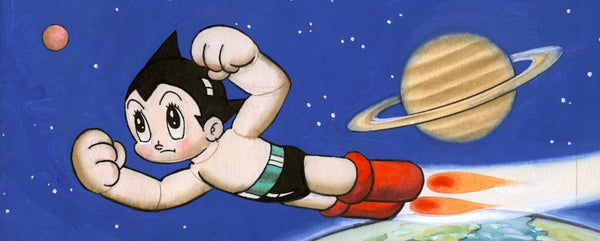
After completing his education, Shinoda moved to Tokyo in 1958 and, at the age of eighteen, became an assistant to Osamu Tezuka. He was, in fact, among Tezuka's first four dedicated assistants.
His arrival in Tokyo came with a remarkable connection to his new mentor. Shinoda moved into Namiki House, where he occupied the exact room previously used by Tezuka. A researcher who knew Shinoda personally even revealed that Tezuka had left behind his drawing desk and apartment deposit for the young artist.
Namiki House occupies an interesting place in manga history. Built in 1953, it had served as Tezuka's home and workplace after his departure from the famous Tokiwa-sō apartment building. The historic Namiki House building survives today and was registered as a Tangible Cultural Property of Japan in 2018.
While working for Tezuka, Shinoda frequently visited the nearby Tokiwa-sō, the legendary apartment complex that became home to an extraordinary generation of young manga artists, including Shōtarō Ishinomori, Fujio Akatsuka and the future Fujiko Fujio duo.
Shinoda's first visit took place around April 1958. As one of Tezuka's junior assistants, he was quickly welcomed into the circle of aspiring artists who regarded Tezuka as their great inspiration. He became particularly close to Motoo Abiko and Hiroshi Fujimoto, the two artists who had been working together under the name Fujiko Fujio since the 1950s.
After working for Tezuka until around 1959, Shinoda established himself as an independent mangaka, making his professional debut with Akebi-chan in Nakayoshi, published by Kodansha. Nakayoshi also featured Tezuka's Princess Knight, making it particularly interesting that teacher and former assistant appeared in the same magazine.
Over the following decades, he developed a successful career illustrating children's comics, humorous manga and educational publications, particularly for Shogakukan and Gakken.
However, his friendship with the Fujiko Fujio artists would become one of the defining relationships of his career. Even after the Tokiwa-sō period, Shinoda remained closely involved with both Fujimoto and Abiko, maintaining a particularly strong friendship with Abiko, with whom he also played amateur baseball.
During the early 1960s, the Fujiko duo established their workplace in Shimokitazawa, where Shinoda was regularly invited to help whenever he had time available. When they moved to the Ichikawa Building in Shinjuku in 1965, and subsequently established Fujiko Studio in 1966, Shinoda continued to collaborate with them.
Although never formally employed by Fujiko Studio, Shinoda was given his own permanent desk at the studio.
This unusual arrangement reflected the close friendship and professional trust between the artists. Shinoda was considered a reliable collaborator who could assist with important assignments, contribute to ongoing productions and take responsibility for entire manga stories when necessary.
Shinoda himself was very particular about this distinction. When asked whether he had been an assistant at Fujiko Studio, he reportedly explained that he had simply been helping his friends when invited. He considered himself a disciple of Osamu Tezuka, not of Fujiko Fujio.
His strong personality and demanding approach to manga production also earned him a rather colourful reputation. According to an anecdote within the Fujiko community, he was referred to as the "Drill Sergeant of Fujiko Studio" (Fujiko Studio no Oni-Gunsō), although the nickname is not firmly documented as an official studio designation.
His contributions extended to various manga associated with Fujiko Fujio A, including Kaibutsu-kun (The Monster Kid) and The Laughing Salesman, alongside numerous illustrations, promotional drawings and adaptations of Fujiko characters.
In 1965, Shinoda's relationship with Fujimoto and Abiko went considerably further than occasional assistance when he began collaborating on Bokunchi no Tako-kun (Our House's Little Octopus), published from 1965 to 1967 under a joint Fujiko Fujio and Hideo Shinoda credit.
Another important collaboration was Berabō (1968–1969), for which Fujimoto drew and inked the main characters, while Shinoda handled the additional characters and finishing work. Some of the extra characters were even designed and named by Shinoda.
This demonstrates that his contribution was not limited to reproducing artwork prepared by another artist. He was actively participating in the creative development of the manga.
In late 1969, Fujimoto found himself increasingly occupied with the simultaneous launch of Doraemon and Mojacko. To ease his workload, Hideo Shinoda was entrusted with illustrating seven chapters of Fujimoto's existing series Umeboshi Denka, published in 1970.
Fujimoto prepared the rough storyboards, character arrangements and dialogue, while Shinoda completed the detailed pencil drawings and final inked pages.
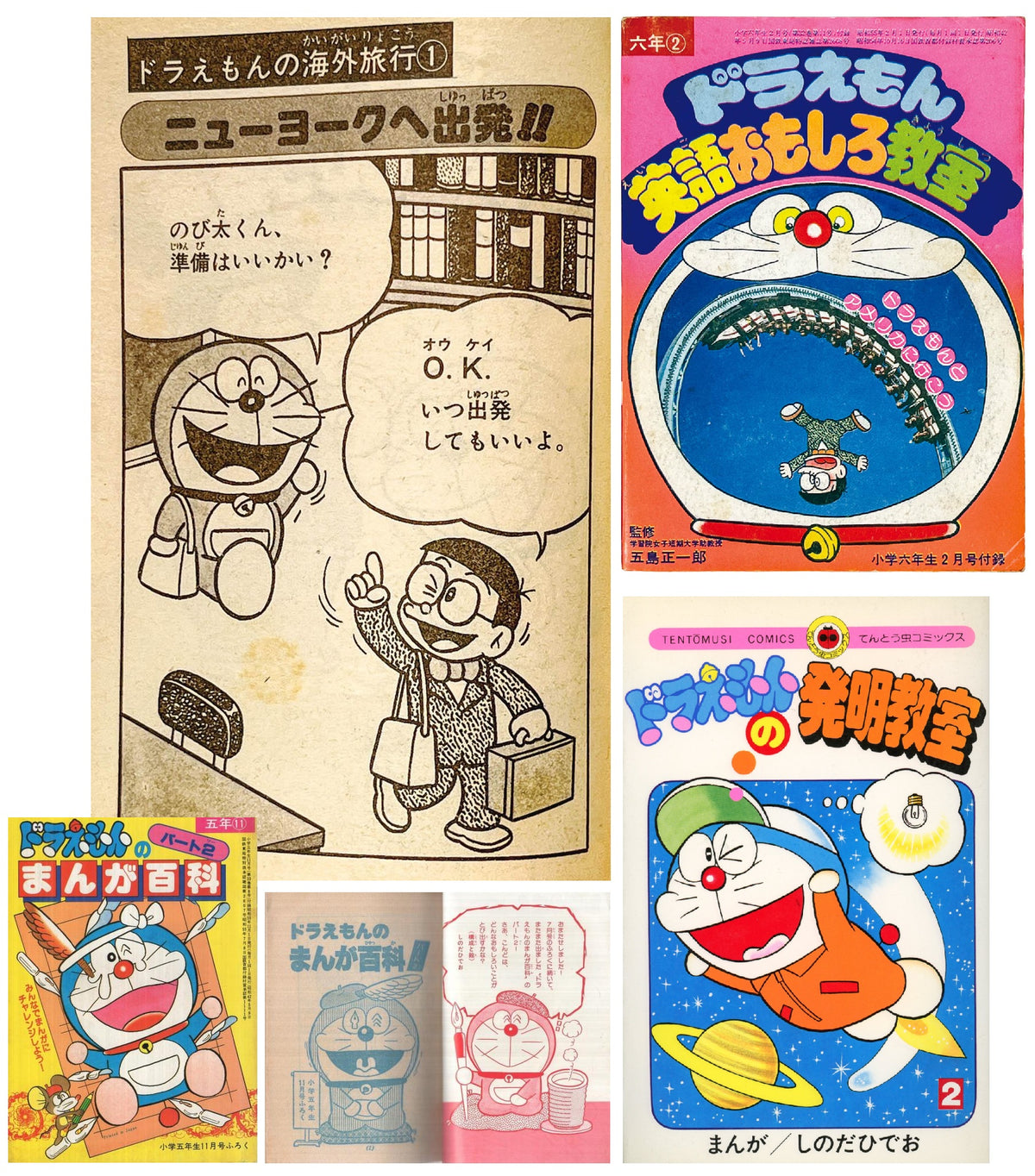
In the following years, Shinoda became increasingly involved in official productions featuring Fujiko Fujio's characters. In October 1976, Doraemon's English Classroom began appearing in Shogakukan's Sixth Grade Magazine. This educational series, illustrated by Shinoda, continued until March 1984.
During the same period, he also contributed Doraemon manga material to Televi-kun (1977–1978), followed by one of his most remarkable collaborations with Fujimoto: Dora Q Perman, a special crossover manga published in CoroCoro Comic in August 1979, bringing together three of Fujiko Fujio's most famous creations: Doraemon, Obake no Q-Tarō and Perman.
For this crossover, Fujimoto prepared the rough storyboards, including the panel arrangements and character positions. Shinoda then developed these into finished pencil drawings before inking the complete manga.
Interestingly, Shinoda did not consider his role to be that of a simple imitator. In an interview published in 2003, he explained that attempting to reproduce Fujimoto's drawing style too closely made his artwork stiff and less expressive.
Instead, he preferred to draw the characters in his own recognisable style, maintaining their personalities while preserving his own artistic identity. He regarded the resulting artwork as his interpretation of Doraemon, rather than an exact imitation of Fujimoto.
This individuality is particularly noticeable in his illustrations of Doraemon, whose expressions and movements often differ subtly from those in the original manga.
One of Shinoda's longest-running and best-known contributions to the Doraemon universe was Doraemon's Invention Classroom.
With Doraemon's English Classroom already under his belt, Shinoda began working on this new series, which first appeared in Shogakukan's Fifth Grade Magazine in April 1978. It continued until the March 1989 issue, an uninterrupted run of almost eleven years. Between April 1986 and March 1989, the series also appeared in Shogakukan's Sixth Grade Magazine.
Invention Classroom was built around an unusual and very entertaining concept: children from all over Japan were invited to submit their own inventions and ideas for new gadgets. Shinoda would then transform these inventions into short manga stories featuring Doraemon.
In the stories, Doraemon introduces the inventions, explains how they are supposed to work and evaluates their usefulness. His reactions are often surprisingly critical, and many of the inventions lead to comical situations or unexpected complications.
Some inventions were practical attempts to solve everyday problems, while others were completely absurd, reflecting the imagination of their young creators.
The manga regularly identified the children responsible for the inventions, mentioning both their names and the Japanese prefectures where they lived. This gives the stories a particularly charming documentary quality, preserving not only the drawings but also the imagination of individual Japanese schoolchildren during the period.
The inventions covered an enormous range of subjects, including household appliances, school equipment, security systems, transport, energy-saving devices, clothing and other unusual gadgets intended to make everyday life easier.
The series was written and illustrated by Hideo Shinoda, with Fujiko Fujio, specifically Hiroshi Fujimoto, credited as supervisor.
The extent of Fujimoto's direct creative involvement in individual episodes has not been established. Unlike Dora Q Perman or Umeboshi Denka, where his contribution to the storyboards is documented, there is no comparable evidence that he personally supplied the scenarios or layouts for Invention Classroom.
Nevertheless, the official supervisory credit and Shinoda's established working relationship with Fujimoto place the series firmly within the authorised Doraemon publishing universe.
The enormous popularity of Doraemon during the late 1970s made the character particularly suitable for this educational concept. In the regular manga, Doraemon constantly produces extraordinary inventions from the future. In Invention Classroom, the situation is almost reversed, with ordinary Japanese children presenting their own inventions to Doraemon for examination.
Despite its 11year publication history, Doraemon's Invention Classroom was collected into only two tankōbon, both published in 1985. Together, they contain approximately 380 pages of material. Consequently, a substantial proportion of Shinoda's work on the series has never been collected in book form.
In May 1979, Shinoda also took over Fujiko Fujio's Introduction to Manga, a feature in which children submitted their own manga drawings and stories for Shinoda to evaluate and discuss.
By this time, Shinoda had become one of the most active collaborators working with Fujiko Fujio's characters. Between 1979 and 1984, he was simultaneously responsible for three long-running educational series: Doraemon's English Classroom, Doraemon's Invention Classroom and Fujiko Fujio's Introduction to Manga.
Alongside these regular assignments, he also produced special Doraemon manga, illustrated encyclopedias and other educational publications. His involvement continued well into the 1980s, including a new series of Obake no Q-Tarō manga published between 1985 and 1987.
Looking back on this important period of his career, Shinoda was clearly more than an illustrator of children's entertainment. He was also an artist who actively encouraged children to develop their own creativity.
He produced numerous educational manga for Gakken, including works on science, nature and history. His earlier publications included Kodomo Manga Gakkō (Children's Manga School, 1967), for which Fujimoto and Abiko provided the cover artwork while Shinoda created the instructional content.
In 1995, Shinoda began teaching at Ogaki Women's College, eventually becoming a professor and vice-president. He retired from the college in 2011.
His career remains particularly interesting because of his close association with two generations of Japanese manga history. Having begun his professional life under Osamu Tezuka, he subsequently worked alongside Fujiko Fujio during the development of some of Japan's most successful manga franchises.
Through collaborations such as Berabō, Umeboshi Denka and Dora Q Perman, as well as his own long-running Doraemon's Invention Classroom, Shinoda made a significant contribution to the history of Japanese children's manga.
Note: Original manga artwork drawn by Fujiko F. Fujio himself is exceptionally difficult to find on the collectors' market. Approximately 50,000 of his original drawings are preserved by the Fujiko F. Fujio Museum in Kawasaki, where they are carefully stored and selectively exhibited. Consequently, original published Doraemon artwork created by the small circle of professional artists closely associated with Fujimoto is an interesting alternative for collectors seeking original art connected to this historic series.
Share