

Hiroshi Kaizuka
Biography | Hiroshi Kaizuka (1938–2023)
Biography | Hiroshi Kaizuka (1938–2023)
Couldn't load pickup availability
Hiroshi Kaizuka (1938–2023)
Hiroshi Kaizuka was a Japanese mangaka active from the late 1950s to the early 2000s, known for his energetic storytelling and for shaping the early style of shōnen manga.
Kaizuka was already drawing manga with classmates during middle and high school. After graduation, he tried a regular job but quit after just six months, deciding that drawing manga was what he truly wanted to do.
He made his professional debut in 1957 with Kojiki to Tonosama (“The Beggar and the Lord”), a kashihon manga published by Tokyo Kotobuki Shobō. A year later came his big breakthrough: Kurikuri Pitcher, serialized in Omoshiro Book (Shūeisha). This lively baseball manga, packed with eccentric rivals and impossible pitches, became a huge hit and helped shape the template for sports manga. It ran for more than 6 years and filled nearly 20 volumes, an impressive accomplishment for the time.
During the 1960s, Kaizuka became one of the most recognizable names in sports manga, refining the mix of determination, rivalry and humor that defined his style.
When Weekly Shōnen Jump launched in 1968, Kaizuka was invited to join its lineup of mangaka.
He contributed Chichi no Tamashii (“Father’s Soul”) to the magazine’s first issue, but the pace of weekly serialization proved overwhelming, forcing him to take a short break. His spot was temporarily filled by newcomer Hiroshi Motomiya, whose Otoko Ippiki Gaki Daishō (“The Rowdy Leader”) soon became one of Jump’s early flagship series.
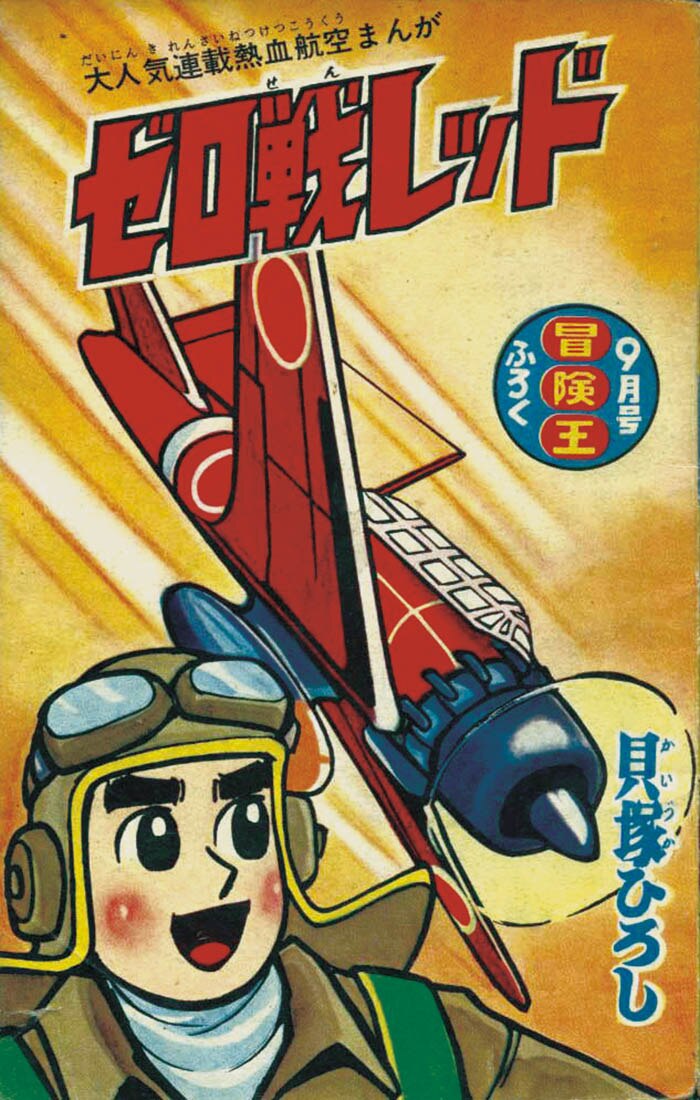
Beyond baseball, Kaizuka also made his mark with two important aviation manga, Zero Fighter Red and Zero Fighter March, both set during the Pacific War but offering very different perspectives on the conflict.
Zero Fighter Red (1961–1966), published in Bōken Ō (Adventure King) by Akita Shoten, follows a group of Japanese fighter pilots who abandon their assigned mission, paint their Zero fighters red and continue the fight for Japan independently. Much of the series appeared as furoku, separate manga booklets included with the magazine, sometimes containing more than fifty pages of adventure. With its spectacular aerial battles and larger-than-life heroes, it became one of Kaizuka’s best-known war adventures.
Zero Fighter March (Zero-sen Kōshinkyoku) takes a more realistic and ultimately tragic approach. Following two brothers from their military training through their careers as fighter pilots, the story ends with both becoming kamikaze pilots and losing their lives. Its heartbreaking final pages, showing their mother sitting beside their grave, offer a striking contrast to the heroic adventures of Zero Fighter Red. Where one celebrates the courage and independence of its fictional pilots, the other reminds readers of the very real human cost of war.
From 1972 to 1975, Kaizuka illustrated Jūdō Sanka (“Hymn to Judo”) for Weekly Shōnen Sunday, written by Ikki Kajiwara. The series ran for 16 volumes and was adapted into a television anime in 1974. During the later Shōwa and Heisei eras, Kaizuka turned toward educational and historical manga, including a ten-volume series on Chinese history and a biography of Kasuga no Tsubone, the influential Edo-period noblewoman and advisor to shōgun Tokugawa Iemitsu, both published by Shūeisha.
Kaizuka also fostered a strong creative community. Through his self-published journal, he collaborated with artists such as Jirō Tsunoda, Yasumi Yoshizawa and Toshio Shōji, several of whom had trained as his assistants. He also inspired a devoted fan base: readers founded the Miracle A Fan Club (ミラクルA友の会), named after one of his popular series, which even produced its own newsletter, a rare show of fan enthusiasm for the time.
In 2020, the town of Onjuku hosted a major retrospective exhibition of his work, one of the earliest and most significant manga exhibitions ever organized in Japan. The show displayed over a hundred volumes and original pages, celebrating Kaizuka’s long career at a time when large-scale manga retrospectives were still in their early years.
Kaizuka continued to create and oversee reprints of his classic stories well into the 1990s and 2000s. He passed away in 2023, leaving behind a legacy that continues to inspire readers and fellow mangaka alike.
Share