

Yoshihiro Tatsumi
Biography | Yoshihiro Tatsumi | 辰巳ヨシヒロ (1935-2015)
Biography | Yoshihiro Tatsumi | 辰巳ヨシヒロ (1935-2015)
Couldn't load pickup availability
Yoshihiro Tatsumi (1935-2015) did not simply draw manga, he helped reinvent what manga could be.
As a teenager growing up in the ruins of postwar Osaka, he discovered the work of Osamu Tezuka and became part of the first generation of artists profoundly shaped by Tezuka’s cinematic storytelling. Tatsumi and his older brother, future publisher and mangaka Shoichi Sakurai, contributed amateur comics to magazines, participated in reader competitions, and eventually gained Tezuka’s acquaintance, visiting the master’s home in Takarazuka several times before Tezuka moved to Tokyo.
Yet Tatsumi soon began moving in a different direction. While Tezuka’s manga often embraced fantasy and adventure, Tatsumi became increasingly interested in harsher, more adult stories inspired by crime fiction, newspaper headlines, cinema, and the psychological atmosphere of postwar Japan.
After his debut in the early 1950s, Tatsumi entered the booming kashihon (rental-book) market. In an astonishingly productive three-year stretch, he created seventeen book-length manga along with numerous short story collections, rapidly becoming one of the major young talents of the rental manga world. Working closely with fellow artists such as Masahiko Matsumoto and Takao Saito, Tatsumi helped push manga away from children’s entertainment and toward something darker, more ‘film noir’, and more psychologically realistic.
At the influential rental manga anthology Kage (“Shadow”), Tatsumi and his colleagues experimented with what he later called “anti-manga manga”, stories stripped of slapstick humor and childish optimism. Instead, they pursued tension, violence, loneliness, and realism. To increase productivity, Tatsumi, Matsumoto, Saitō, and the artist Kuroda were placed together in a shared apartment studio in Osaka’s Tennōji ward, a legendary “manga camp” where young artists lived and worked side by side during the explosive birth of gekiga.
In this period, Yoshiharu Tsuge would also emerge as another key figure of this new adult-oriented current, developing a parallel but deeply personal approach to psychological and introspective manga that would later reinforce gekiga’s broader cultural impact.
In 1956, Tatsumi produced the landmark thriller Black Blizzard, a work now often regarded as one of the earliest masterpieces of dramatic manga storytelling. Filled with speeding trains, cinematic angles, diagonal compositions, and relentless pacing, the book stunned fellow artists and pointed toward an entirely new visual language for comics.
The following year, in 1957, Tatsumi coined the term gekiga, “dramatic pictures”, to distinguish this new movement from conventional manga. It was more than a simple label: it marked the birth of an entirely new form of Japanese comics aimed at adults rather than children.
The term and the movement initially met resistance from Osamu Tezuka, who was skeptical of this break from mainstream manga traditions, though he would later incorporate and adapt gekiga influences into his own late works, including Phoenix and especially Buddha (1983–1985), where elements of gekiga narrative and tone became more fully integrated into his style.
In 1959, Tatsumi, Matsumoto, Saitō, and several other artists formally established the Gekiga Kōbō (“Gekiga Workshop”) in Tokyo, even issuing a kind of “Gekiga Manifesto” to publishers and newspapers declaring the movement’s ambitions.
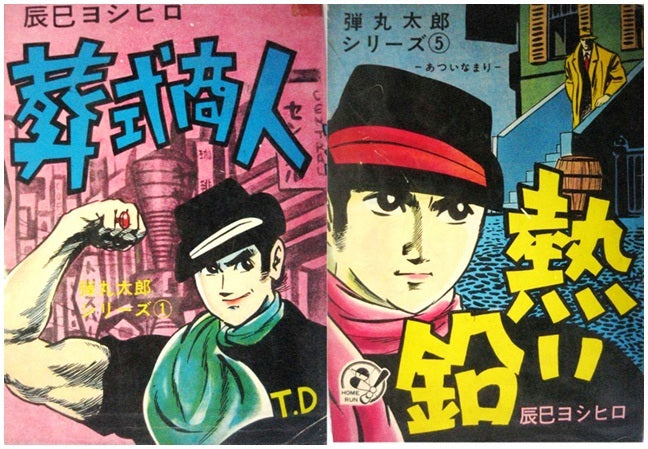
The artwork exhibited here from Funeral Merchant (Sōshiki Shōnin / 葬式商人), published in 1962 as part of the Bullet Tarō (Dan’gan Tarō) series, comes from a pivotal period in Tatsumi’s career.
Tatsumi had already established himself as one of the main mangaka of the gekiga movement, yet his later ultra-minimalist and psychologically oppressive style had not yet fully emerged.
Funeral Merchant retains the feel of pulpy action storytelling, a noir-inspired atmosphere, cinematic pacing, and the raw energy of the gekiga boom.
In this ten-part series, Tatsumi stands between two worlds: the postwar adventure manga tradition and the bleak human dramas that would later define his international reputation.
During the 1960s and 1970s, Tatsumi increasingly focused on stories about society’s forgotten figures: factory workers, failed salarymen, prostitutes, criminals, and isolated dreamers trapped beneath Japan’s rapid economic growth.
While many artists imitated gekiga’s visual style, Tatsumi himself became frustrated with works that reduced gekiga to mere violence or sensationalism. For him, the movement was never about spectacle, but about emotional realism and adult human experience.
Magazines such as Garo became important homes for a new wave of experimental manga, and Tatsumi’s work there helped define the emerging world of alternative and literary comics in Japan.
In 1970, he entered another major creative breakthrough with a series of bleak, deeply human short stories collected in Abandon the Old in Tokyo. Published in English by Drawn & Quarterly, the collection would go on to win a Harvey Award and receive Eisner Award nominations decades later, helping cement Tatsumi’s international reputation.
From the 2000s onward, Tatsumi’s work found a worldwide audience through new translations and reprints championed by cartoonists such as Adrian Tomine. Canadian publisher Drawn & Quarterly launched an ambitious project publishing yearly collections of his work, while his autobiographical masterpiece A Drifting Life won numerous international awards, including the prestigious Tezuka Osamu Cultural Prize.
In 2011, Eric Khoo adapted Tatsumi’s life and stories into the animated feature film Tatsumi, introducing yet another generation to the artist who transformed manga into a mature artistic medium.
Update:
Additional research has revealed that the Bullet Tarō series consisted of at least ten volumes published between roughly 1962 and 1964, but released by three different publishers: Central Bunko, Tokosha, and Daiichi Pro. Recognizable by his trademark hat and scarf, Bullet Tarō appeared on all ten covers.
There was even a “Bullet Tarō Song,” reportedly written by Tatsumi himself, although no physical copy has yet surfaced and its publisher remains unknown.
Bullet Tarō represents a fascinating moment in Yoshihiro Tatsumi’s career. While the series already contains the noir atmosphere, cinematic pacing, and raw energy associated with early gekiga, it still retains the playful action-hero spirit and clear good-versus-evil storytelling of postwar adventure manga.
Share