

Osamu Kishimoto
Biography | Osamu Kishimoto (岸本修) (Fukuoka, 1936–)
Biography | Osamu Kishimoto (岸本修) (Fukuoka, 1936–)
Couldn't load pickup availability
Osamu Kishimoto (岸本修) (Fukuoka, 1936–) is a Japanese mangaka whose career developed during the rapid expansion of magazine manga in postwar Japan.
Active from the mid-1950s onward, he belonged to the generation of professional artists who transformed manga from emonogatari picture-stories, akahon, kashihon, and other early postwar publications into a widely distributed medium through large-circulation magazines for shōnen, shōjo, and teenage readers.
Kishimoto made his debut in 1955 in the boys’ magazine Yakyū Shōnen, where he published short adventure stories such as Chibita-kun and Tengu to Koshirō. These early stories already displayed Kishimoto’s dynamic storytelling and skill across multiple genres.
In the following years, he became a frequent contributor to a wide range of magazines, including Bokura, Shōnen, Shōnen Club, and Omoshiro Book, building a reputation as a skilled, creative, and inventive adventure mangaka.
By the late 1950s, Kishimoto had become a highly productive professional, contributing detective stories, samurai adventures, westerns, and science-fiction narratives to many of the major publishers of the period. His work appeared in magazines issued by editors such as Kodansha, Kobunsha, Shogakukan, Akita Shoten, and Shueisha, meeting the growing appetite for fresh stories during the magazine boom of the late 1950s.
Among his early serial successes were titles such as Kenki Ryūshirō, Ryūsei Tantei, and Speed Boy, which established him as a reliable adventure artist capable of sustaining longer narrative series.
One of Kishimoto’s most notable series emerged in 1960 with the adventure manga Shōnen Senpūji (少年旋風児), translated as Whirlwind Kid.
The series follows the adventures of the young detective Tachibana Goro, who becomes entangled in a series of increasingly dangerous and fantastical conflicts. Across the 8 tankobon, Goro faces a notorious criminal named Jim Boy, contends with immortal villains, combats mysterious criminal organizations, and confronts supernatural threats, including shape-shifting men, deadly plagues, and monstrous creatures.
The stories blend detective action, martial arts, and science-fiction elements, with elaborate battles involving swords, shields, crossbows, and other inventive weapons and devices. The final volume depicts a decisive confrontation spanning decades, bringing Goro to his ultimate confrontation against Jim Boy and other long-standing adversaries.
“Whirlwind Kid” demonstrates Kishimoto’s skill in crafting rapid-fire storytelling, creative storylines and complex action sequences. This manga became one of Kishimoto’s longest-running series and a defining work of his career.
It ran in Hinomaru for close to three years, producing additional chapters and special supplementary episodes, including story arcs such as The White-Haired Demon and The Space Demon.
The series featured fast-paced adventure storytelling typical of boys’ magazines in the early 1960s, combining action, mystery, and diverse settings to engage young readers.
The title Whirlwind Kid doesn’t even refer to a specific element in the story itself, but it conveys a sense of speed and energy, reflecting the adventurous and action-driven tone that appealed to shōnen audiences.
During the early 1960s, Kishimoto continued to produce a wide variety of adventure and science-fiction stories. Works such as Monster X and Uchū Jinrui Nova reflect the growing popularity of sci-fi themes during the era of the space race and the Japanese monster-film boom. Kishimoto also drew historical ninja adventures such as Onmitsu Kenshi – Ninja of Kōga, published in 1963 as a trilogy, and around the same time, he began contributing to the emerging weekly manga magazines, including Weekly Shōnen Sunday, where he serialized the action story Yami no Sakon in 1964.
That same year, Kishimoto became one of the founding members of Hikari Production, a manga studio established under the guidance of Mitsuteru Yokoyama, creator of the landmark robot series Tetsujin 28-go.
The studio also included artists such as Hideo Baba, Yoshikatsu Miyakoshi, and Hideoki Inoue. Hikari Production functioned as a collaboration where artists assisted one another while continuing to produce works under their own names.
Kishimoto himself occasionally published under alternate signatures, mainly stylistic versions of his name written in hiragana or katakana, but in rare cases he also used completely different pen names, such as Yukio Tsukie (月江行男) and Ban Kishimori (岸森伴), the latter appearing on manga connected with Tetsujin 28-go. You can find Kishimoto’s version of Tetsujin 28-go in Adventure King, published between November 1980 and October 1981.
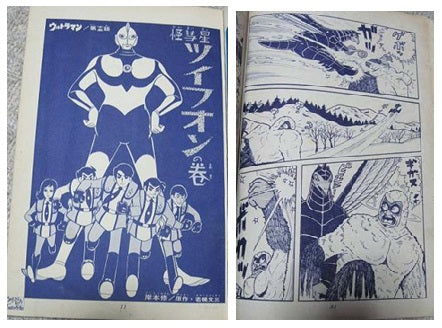
In 1966–67, Osamu produced, as part of the broader manga boom around television series, manga adaptations of the immensely popular Ultraman. Bemular, Green Monster, and Mysterious Comet Typhon were published by Gendai, and he also produced Ultraman-related manga for the children’s magazine Bokura (1967).
During the 1970s, his work shifted increasingly toward the emerging adult manga market, appearing in magazines such as Leed Comic and Young Comic, where he drew stories centered on gambling, horse racing, and the Japanese underworld. Kishimoto remained active for decades, with a career spanning nearly half a century—from the formative magazine boom of the 1950s to the mature industry of the late twentieth century.
Osamu Kishimoto’s work is no less then a testament to the imagination and drive of postwar manga artists. Whirlwind Kid (Shōnen Senpūji) remains his signature achievement, a whirlwind of action, intrigue, and inventive spectacle that captured the hearts of young readers. His career reflects both the collaborative spirit of mid-century manga studios and the distinctive voice of an artist capable of shaping stories that remain vivid long after their original publication
Share