

Tetsuo Ogawa
Biography | Tetsuo Ogawa (小川哲男, 1912–1984)
Biography | Tetsuo Ogawa (小川哲男, 1912–1984)
Couldn't load pickup availability
Tetsuo Ogawa (小川哲男, 1912–1984) was a Tokyo-born manga artist whose career began in the early 1930s and reflects the continuity of Japanese manga and cartooning from the prewar magazine era into the postwar period.
In 1931, at the age of nineteen, Ogawa made his professional debut after winning first prize in a manga contest organized by the Hōchi Shimbun. He subsequently joined the newspaper (1933–1936) and became affiliated with Manga Shūdan, the influential prewar collective of professional cartoonists founded in 1932 and centered around figures such as Yokoyama Ryūichi and Tagawa Suihō.
Manga Shūdan played a central role in shaping mainstream humorous and adventure manga before the rise of postwar story-driven narrative styles.
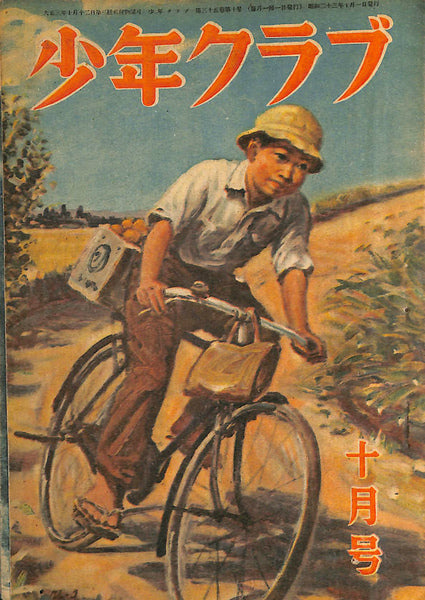
During the 1930s and 1940s, Ogawa contributed to widely read magazines such as Shōnen Club (Kodansha), with 29 known publications between 1946 and 1954, one particularly popular serialized title being The Adventures of Putcher the Monster Star.
Yōnen Club, also published by Kodansha, featured Stylish Ton-chan and Rome Connection in 1948–49, while Gin-chan's Surprising Adventure was published by Ikuei Publishing.
Ogawa’s manga was omnipresent, with further publications appearing in Shōjo Club, Fujin Club, Manga Mitaruki Kyokuzasshi, Monthly Yomiuri, Kodomo no Hikari (“Children’s Light”), Shōnen, and King.
In fact, when researching Ogawa’s work in the Japanese National Library, we found no fewer than 1,254 publications (admittedly including reprints, but still 😊).
Tetsuo produced lively adventure and gag-oriented series for young readers. Among the works represented in our collection are Pit’s Adventure Map (ピットの冒険地図), Porin’s Dark Journey (ポリンの暗黒旅行), and Apon, the Seventh Continent (第七大陸アポン).
Apon, the Seventh Continent was published in Chūgakusei no Tomo, a magazine for junior high school students issued by Shogakukan (1949).
Both Gakken and Nakayoshi published Porin’s Dark Journey (1949), first in a children’s science magazine and later in Nakayoshi Book, the predecessor of Kodansha’s girls’ manga magazine Nakayoshi.
Pit’s Adventure Map appeared in 10 consecutive issues of Shōnen (1949–50) and was later released as a beautiful album edition by Kobunsha.
All three titles are surprisingly progressive in their themes, featuring a quickly drawn, almost childlike akahon-style graphic approach combined with an emonogatari (illustrated story) layout.
Additional lively titles by Tetsuo Ogawa from that period include Upon the Seventh Continent, The Demon of Great Kanthal, Jinzo Dog Operation, Bustling Moon World, American Hawksbill, and The Count of Monte Cristo.
These works reflect the imaginative spirit and magazine format characteristic of prewar and early postwar Japanese manga, blending humor, exploration themes, and dynamic cartooning.
By the early 1950s, as Japan’s publishing industry reorganized, Ogawa shifted toward adult-oriented magazines and became a regular contributor to Manga Reader, published by Bungeishunjū.
While many younger artists were pioneering cinematic long-form narratives, Ogawa remained rooted in the gag and satirical cartoon tradition. Known for his sharp wit, he also appeared regularly on NHK’s Wit Classroom, reinforcing his public identity as a comic artist beyond the printed page.
NHK’s “Tonchi Kyōshitsu”, often translated as Wit Classroom, was a very popular radio quiz and comedy program and one of the best-known entertainment broadcasts of early postwar radio.
In addition to his creative work, Ogawa later served as a director of the Japan Cartoonists Association and taught at Chiyoda College of Arts and Technology, contributing to the professional structure and development of manga in the postwar decades.
Ogawa’s career represents an important but sometimes overlooked strand of manga history: the enduring tradition and struggle of the prewar comedic mangaka and storyteller, rooted in magazine publications, visual humor, and playful adventures, which continued alongside the major stylistic transformations of postwar twentieth-century manga.
In 1951, Kodomo Manga Graph published Pikachu Detective … unrelated, of course, to the later Pokémon character.
Share